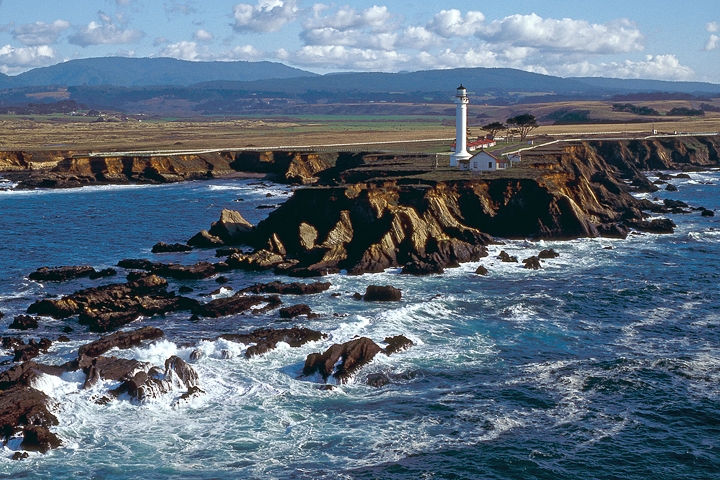
Point Arena Lighthouse
The tallest lighthouse on the West Coast — climb 145 steps of a 1908 reinforced-concrete tower to a working Fresnel lens and 360-degree Pacific views.
- Mon 10:00 AM – 4:30 PM
- Tue 10:00 AM – 4:30 PM
- Wed 10:00 AM – 4:30 PM
- Thu 10:00 AM – 4:30 PM
- Fri 10:00 AM – 4:30 PM
- Sat 10:00 AM – 4:30 PM
- Sun 10:00 AM – 4:30 PM · Today
Along Highway 1
Leg times are driving estimates along Highway 1.
South to north along Highway 1: Stewarts Point Store, then ~5 min to Sea Ranch Lodge, then ~15 min to Gualala Downtown, then ~25 min to Point Arena Downtown. Point Arena Lighthouse is the venue on this page.
Nearby
A short drive
- Point Arena Stornetta Coastal Trail 1.6 mi SE
- Pier Place 3.2 mi SE
- Point Arena Pizza 3.2 mi SE
- Cove Coffee 3.2 mi SE
Lighthouse
Point Arena Lighthouse marks Point Arena — where the California coast bends from northwesterly to due north — a turning point that made a light here essential once redwood-lumber shipping out of the North Coast picked up in the 1850s and 1860s. The original brick tower and keepers' dwelling went up in 1869–70 and first lit on May 1, 1870, one of three tall coastal towers built in that style in California alongside Pigeon Point and Piedras Blancas.
The Great Earthquake of April 18, 1906 tore the brick tower apart — a keeper on duty described it swinging violently north and south before the lens and reflectors shattered on the lantern room floor. Learning from that failure, the Lighthouse Board rebuilt in reinforced concrete: iron bars woven into wooden forms and filled with poured concrete, raised by a mule-powered elevator. The new 115-foot tower — the first lighthouse in the country built this way — was completed in 1908 and fitted with a first-order Fresnel lens that produced a double flash every six seconds, turned by a clockwork mechanism and a 160-pound falling weight the keepers wound by hand every two hours.
The light station was automated in 1977. The nonprofit Point Arena Lighthouse Keepers took over the site in 1984 and were awarded ownership in 2000; the station was added to the National Register of Historic Places in 1991. Today the tower, fog signal building museum, and 23-acre grounds are open for self-guided and tower-climb visits, run entirely on visitor admission and membership support rather than any state or federal parks budget.
The climb itself is 145 steps up a spiral staircase to the lantern room gallery, where a volunteer guide lets you step outside onto the balcony for 360-degree views — the coastline you drove in on, the Devil's Punchbowl sinkhole, and Arena Rock just offshore — before taking you up to the light. The original first-order Fresnel lens now sits in the Fog Signal Building museum, moved from the tower during a 2008–2010 renovation, alongside exhibits on shipwrecks, the lumber trade, and Pomo history, and a self-guided Outdoor Museum route crosses the 23-acre grounds. On the Saturday nearest each full moon, a separate ticketed evening tour climbs the tower by moonlight, with sparkling cider or champagne at the top.
The bluff the lighthouse sits on is actively eroding; the Light Station has discussed that the tower may need to be moved back from the edge within a few decades if funding allows.
Before You Go
- Hours: daily 10 a.m.–3:30 p.m. (10 a.m.–4:30 p.m. Memorial Day weekend through Labor Day); closed Thanksgiving and Christmas Day, with a shortened 10 a.m.–1 p.m. day on December 24.
- Site Visit Fee: $5 per person (12 and older) for the Light Station Store, Fog Signal Building Museum, and Outdoor Museum; children under 12 free.
- Tower Tour: an additional $5 per person, ages 6 and up (not permitted under 6); tours run roughly every 20 minutes, first one around 10:15 a.m., last around 3 p.m.
- Free-admission days: Point Arena Light Station Anniversary (May 1), National Lighthouse Day (August 7), and a handful of other observance days through the year.
- Group rates are available for the Indoor and Outdoor Museums — contact the Light Station directly to arrange.
- Gift shop: the Light Station Store carries lighthouse and local-history merchandise and is included in the Site Visit Fee.
- Nearby: the site sits within the California Coastal National Monument's Point Arena–Stornetta Unit, so a visit pairs naturally with the surrounding public coastal lands
What visitors say
- The stair climb is a real climb — one visitor described the spiral staircase as "not for the faint of heart," with about 100 feet of elevation gain that leaves most people breathing hard by the top (California Through My Lens).
- The volunteer guides make it — visitors consistently mention the volunteer stationed at the top who walks you around the gallery and shares the tower's history and the site's ongoing erosion concerns before you head back down.
- The museum surprises people — several accounts note being unprepared for how large the original lens is up close, and for the depth of the shipwreck and local-history displays in the Fog Signal Building.
- A genuine bucket-list stop on Highway 1 — described as "a must-visit" and "one of the better lighthouses in California" for anyone road-tripping the Mendocino coast (California Through My Lens).